Complexity and Effort
A Strategic Investment
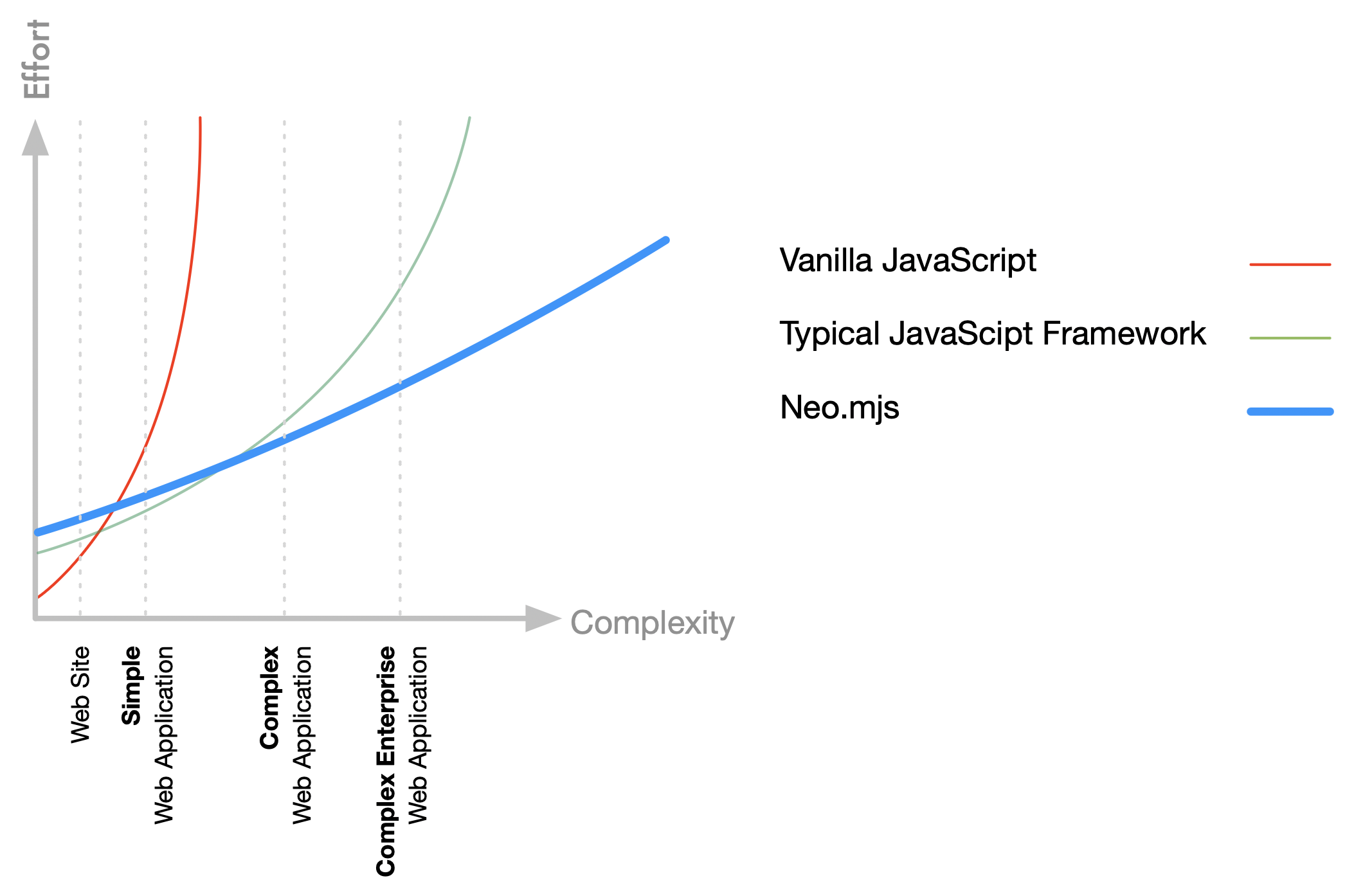
In the world of web development, the relationship between application complexity and the effort required to build and maintain it is rarely linear. As the chart below illustrates, traditional JavaScript frameworks and even vanilla JavaScript often lead to an exponential increase in effort as applications grow in features, data, and user interactions.
The Neo.mjs Advantage: A Linear Path to Scalability
Neo.mjs presents a fundamentally different curve. While there might be a slightly higher initial learning curve or setup effort compared to starting with a trivial vanilla JavaScript website, this upfront investment is a strategic advantage. Developers typically get "up to speed" with Neo.mjs within about a week, grasping its core concepts and unique architecture.
This initial effort is quickly recouped, leading to a significant "turning point" where developer productivity skyrockets. Once familiar with the Neo.mjs paradigm, the effort required to implement increasingly complex features scales almost linearly. This is a stark contrast to other frameworks where complexity often translates into spiraling costs, diminishing returns, and a constant battle against technical debt.
Why Neo.mjs Maintains Linearity:
Neo.mjs achieves this remarkable linearity through a combination of architectural innovations and developer-centric design:
Unified Config System: All aspects of your application—from UI components and layouts to data models, controllers, and routing—are defined declaratively through a consistent, hierarchical configuration. This eliminates the need to learn disparate configuration paradigms, significantly reducing cognitive load and development time as complexity increases.
Off-Main-Thread Architecture (OMT): By offloading business logic and data processing to Web Workers, Neo.mjs ensures the main thread remains responsive, even in highly complex, data-intensive applications. This inherent separation of concerns prevents UI freezes and simplifies debugging, as performance bottlenecks are isolated and easier to identify. The multi-threaded nature also inherently supports technical scaling by distributing computational load across CPU cores.
Predictable Component Lifecycle: The well-defined and consistent lifecycle of Neo.mjs components, from creation to destruction, provides clear hooks for managing state and resources. This predictability reduces the likelihood of memory leaks and unexpected behavior, making complex applications more stable and easier to maintain.
Modular and Scalable Design: Neo.mjs encourages a modular approach, allowing developers to build complex applications from smaller, self-contained, and reusable components. This design philosophy, combined with features like intelligent lazy loading, ensures that even massive enterprise applications remain manageable and performant.
Reduced Build Tooling Overhead: The zero-build development mode and native ES module support minimize reliance on complex build configurations and transpilation steps. This accelerates the development feedback loop, allowing developers to iterate faster and focus on writing application logic rather than wrestling with tooling.
This linear relationship translates directly into tangible benefits: faster development cycles, lower maintenance costs, and a more predictable path to scaling your applications, regardless of their eventual complexity. For decision-makers, this means a more efficient use of development resources and a higher return on investment for web application projects.